Belief-conditioned agency
Agency from a persistent belief state, without the harness.
Thesis
Native belief-conditioned agency does not need the control artifacts of today's LLM-centered agents: system prompts, instruction and identity files, flat memory files, compaction, or prompt-centric tool selection. The LLM, tools, channels, CLI commands and APIs can still be reused. Agency does not depend on them.
Definition
Belief-conditioned agency: the system's evolving beliefs, uncertainty, provenance, temporality, hypotheses, conclusions, dissonance and learned world dynamics are the substrate that determines identity, interpretation, attention, reasoning, coordination and action.
Abstract
Current agents are LLM loops wrapped in explicit control artifacts. Prompts and instruction files set identity and rules. Context windows, retrieval and memory files rebuild the past. Workflow graphs constrain paths. Tool descriptions and routing prompts pick actions. Effective for bounded, explicit work. Brittle when work is long-running, implicit, ambiguous, contradictory, incomplete or always changing.
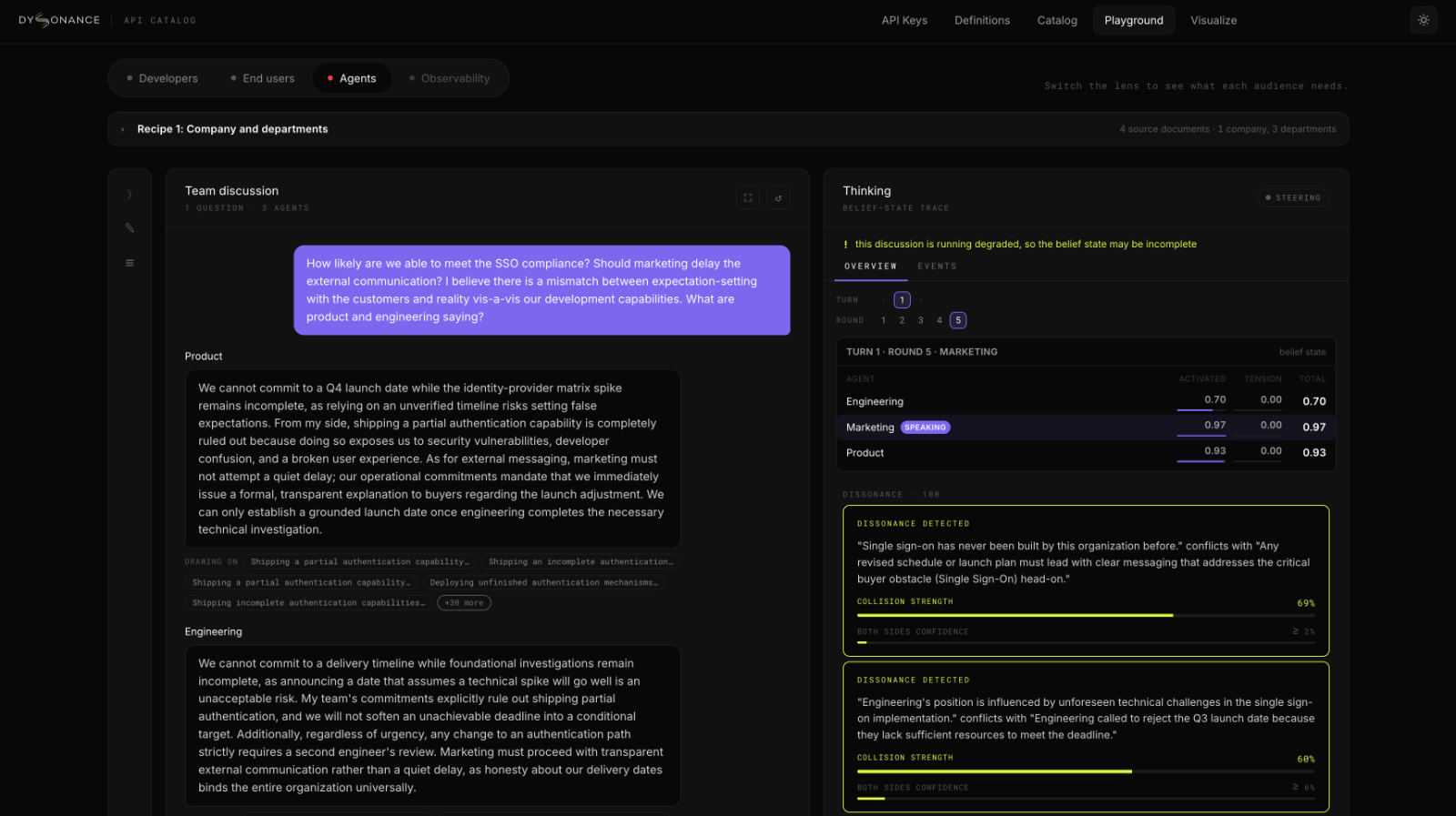
A persistent belief state represents what a person, team, company or agent fleet believes, with confidence, uncertainty, provenance, time, supporting and contradicting evidence, relationships and unresolved dissonance. Relevant parts activate as the system observes, reasons and acts. The belief state replaces identity and memory artifacts. It conditions which information matters, which hypothesis to explore, which agents take part, whether the system knows enough to act, which tools to invoke, whether to abstain or gather evidence, and how results update future state.
Transitions between belief states become learning signals for an Inner World Model, an agent-scoped model of how that world changes. The LLM becomes a replaceable language component. In multi-agent settings, agents hold distinct belief states against shared awareness, and disagreement stays explicit.
See how it works in Where agents get agency.