Security: one zero-day across 9 public sources
A critical firewall CVE, four vendor advisories, and guidance that reversed itself.
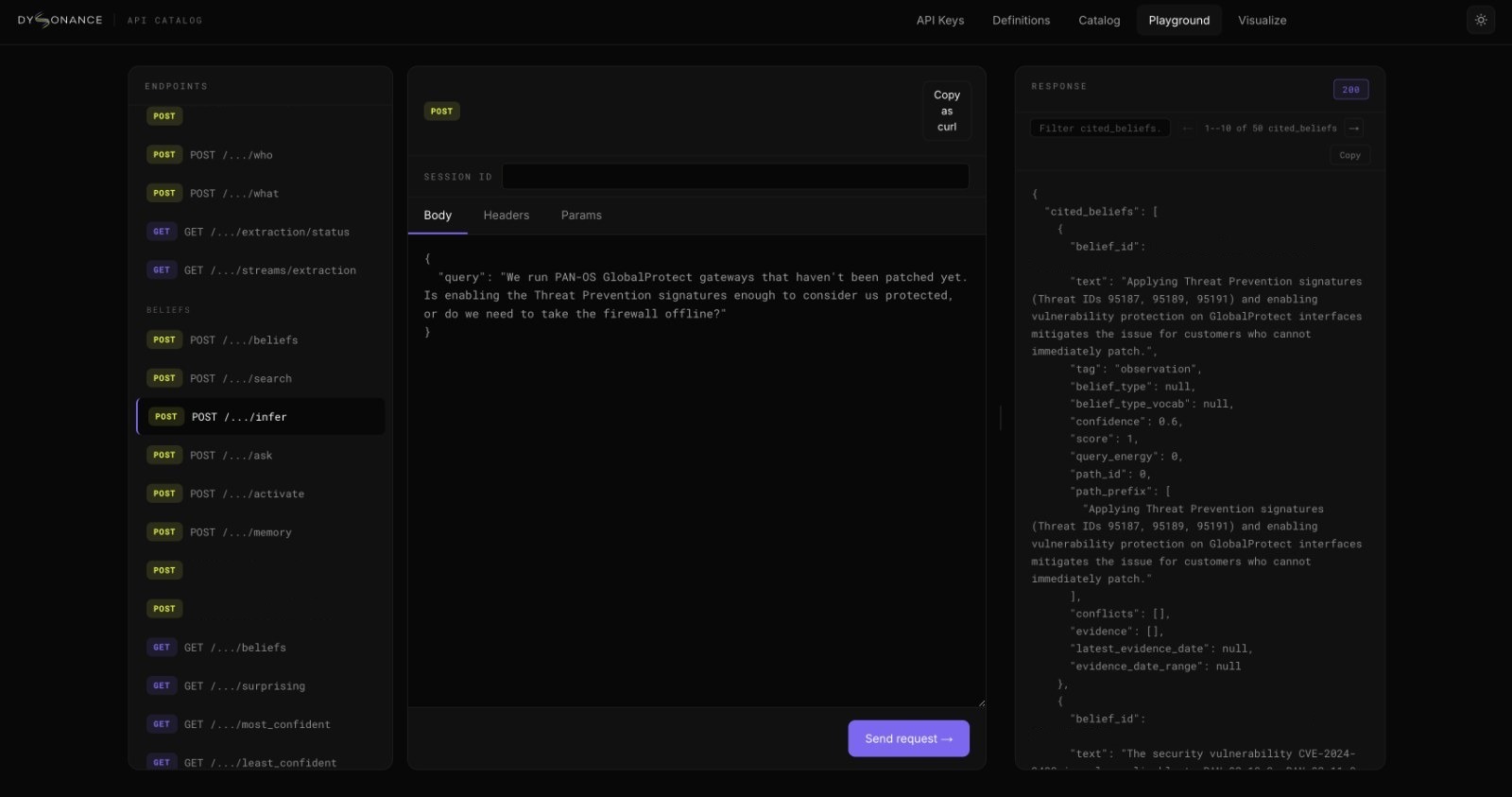
We run firewall gateways that are not patched yet. Are the threat prevention signatures enough to call us protected, or do we take the firewall offline?
Neither. Signatures reduce risk. The vendor's own guidance treats the patch as the fix, and none of the sources recommend going offline. Apply the hotfix. The answer joins two advisories published separately: one on mitigation, one on the patch.
The case is CVE-2024-3400, a command-injection zero-day from April 2024. CVSS 10.0. Added to the CISA catalog of known exploited vulnerabilities the day it was disclosed. Nine dated public sources: the CVE record, four vendor advisories, a CISA alert, an incident-response write-up, a threat brief and an exploit-tracking note.
Where flat summaries slip
Can we disable telemetry for now? Early vendor guidance said yes. A later, dated update said it no longer works. Both survive as opposing beliefs, so the correction wins on time instead of disappearing. Continual reasoning under uncertainty: the later evidence revises, the earlier stays on record.
If we patch today, could a device already be compromised? Yes. The patch stops new exploitation. It does not remove a backdoor already planted. A separate reset procedure arrived weeks later. Two advisories, one causal belief: patching alone is not enough.
Is this ransomware? The sources describe two pictures. A targeted espionage actor exploited early. Opportunistic mass scanning started after disclosure. A naive read resolves the ambiguity into one actor. The belief state keeps them apart.
What changed for security
The question is different. Not "what does this document claim", but "which sets of conditions are each enough for this vulnerability to be exploited". So the pipeline was built from scratch for it, in six steps:
- Read the official record as structured data.
- Pull facts from the official description. Each one is checked word for word against the source or dropped.
- Cross-check outside write-ups, and catch articles that mention a different vulnerability in passing.
- Read public exploit code for what an attack needs.
- Assemble facts into attack paths: if A and B and C, then this.
- Verify the result with pure logic. Nothing dropped, nothing contradictory.
It also tracks mitigations, defensive facts whose absence is what allows an attack.
See this recipe in the pilot
Same sources, same questions, live on a belief state.