Tax: answerable means extracted
Two runs, 44 to 46 beliefs, two missing tax bands, and a headline question taken off the shelf.
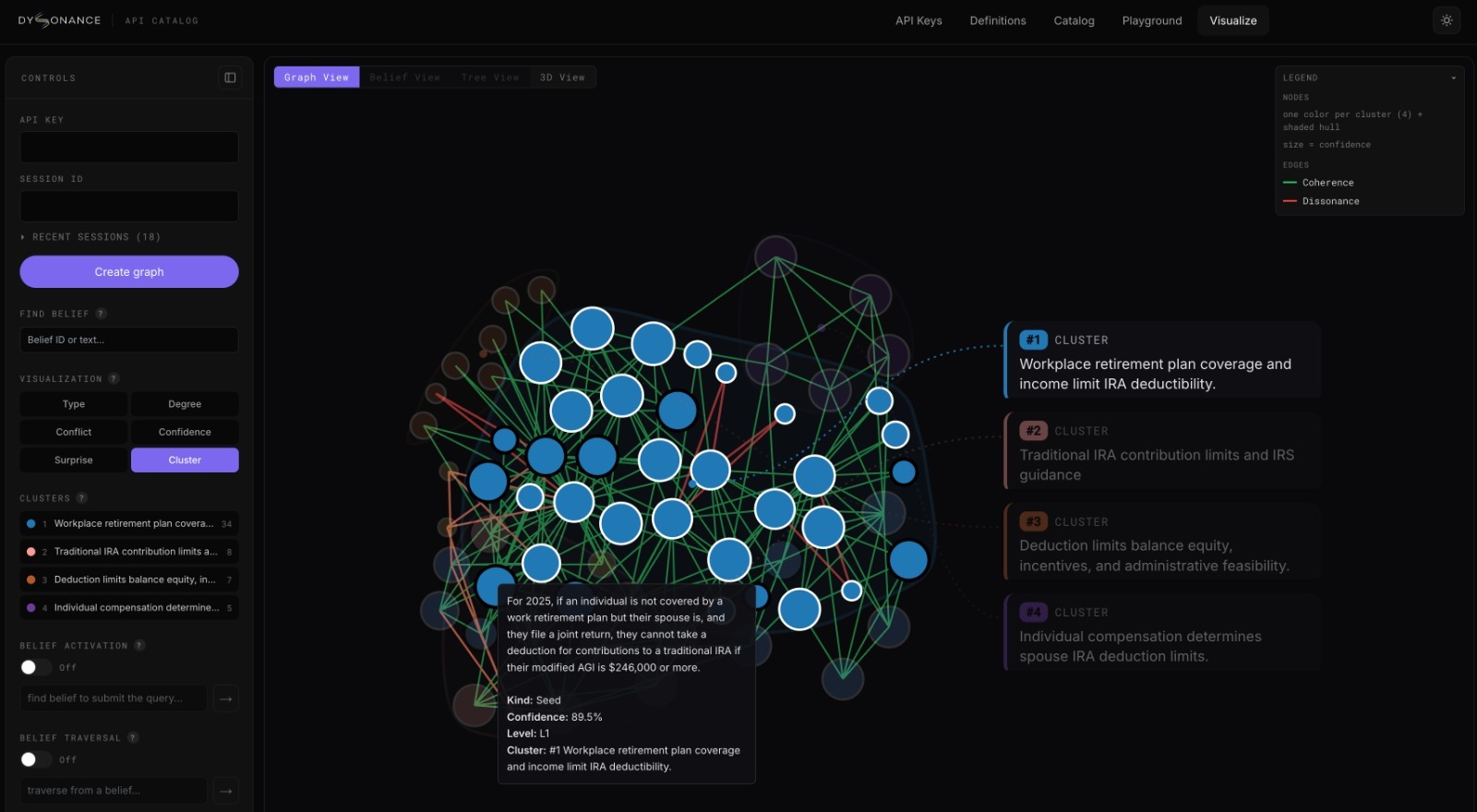
A question counts as answerable only if every fact it needs exists as an extracted belief. Not somewhere in the source. In the belief state, checked against the belief properties. Continual reasoning under uncertainty reasons over what was extracted, nothing else.
The tax recipe runs on one IRS publication, about IRA deductions. Two extraction runs, no domain-specific prompts: 44 and 46 beliefs. Most of the hard parts survived both times. Two did not.
What held
- The single and head-of-household phase-out band: $79,000 to $89,000.
- The married-filing-separately cliff: $10,000.
- The age-50-plus contribution limit: $8,000.
- One employer contribution makes you covered for the whole year.
- The modified AGI here is not the one used for the premium tax credit.
Each one is its own belief, on both runs. So the primary question, a single filer at $85,000 who joined a plan in November, gets a grounded answer: yes, in part.
What did not
The two married-filing-jointly bands: $126,000 to $146,000 when you are covered, $236,000 to $246,000 when only your spouse is. Neither figure appears in any extracted belief, on either run. Dense, adjacent numeric tables are where extraction thins out.
I'm covered at work, we file jointly at $135,000. Full deduction? Not answerable today. The band it needs is not in the belief state.
I'm 52, my spouse is covered, we file jointly at $250,000. How much can I contribute and deduct? Half answerable. The $8,000 limit is a belief. The deduction band is not.
A gap the belief state knows about beats a confident answer it cannot ground.
What changed
The jointly-filed question used to be the headline. It was moved down and kept as a known, reproducible gap instead of being dropped. Shipping a headline the pipeline cannot answer would mislead. It goes back on top once dense tables extract cleanly.
The rule carries to every recipe: answers cite beliefs, beliefs cite evidence, and a missing belief is reported as missing. Handling ambiguity means naming the gap, not guessing past it.
See this recipe in the pilot
Same sources, same questions, live on a belief state.