The Physics of Intelligence
Intelligence is not a mapping learned from data. It is a state that evolves under forces. An overview, and the start of a series.
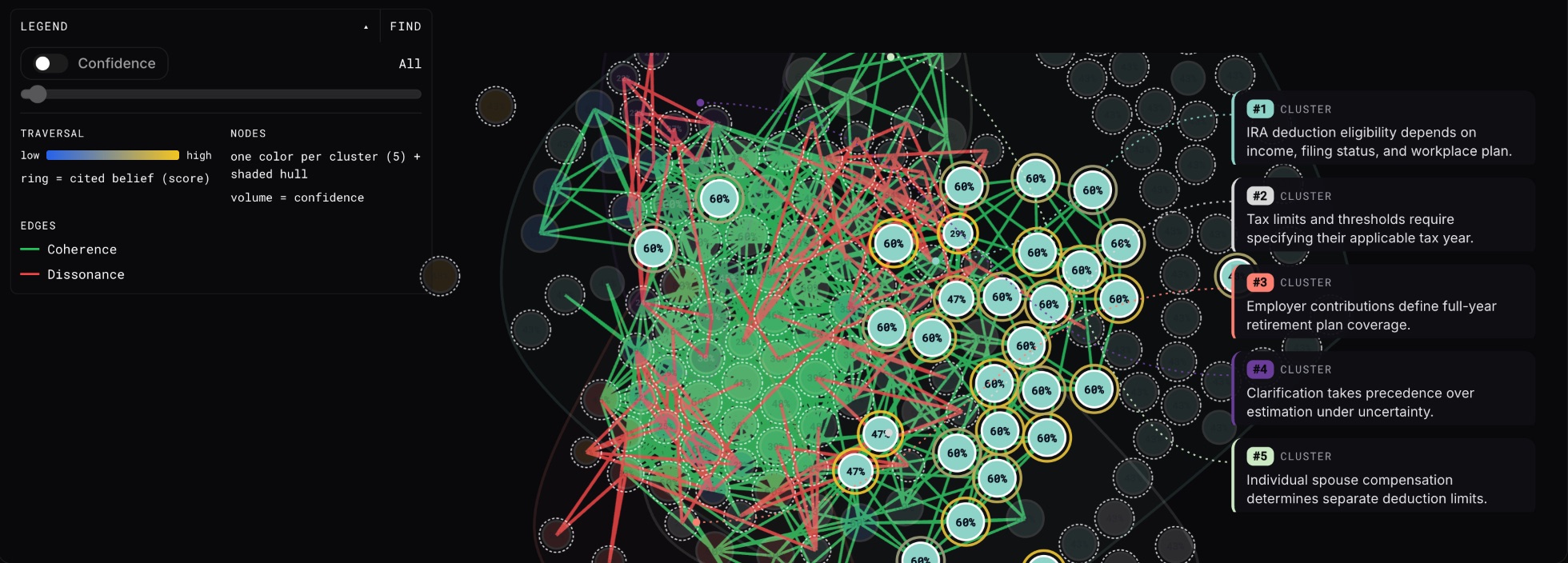

AI rests on one assumption: with enough data, a model recovers the reality behind it. Physics suggests otherwise. Here are the five ideas behind that claim. Each gets its own deep dive in this series.
IInformation is not what we thought
Data is not information, and information is not contained in data. Every observer reports an event from their own frame. Averaging many observers works when you want the mean. It fails when the signal is the exception: the variance, the anomaly, the event almost nobody saw.
Language makes it worse. It was invented to communicate, so it simplifies. Thought collapses into fewer dimensions when it is spoken. Two people say the same words and mean different things. Language is not an invertible function of thought.
We mistook an observable of cognition for the substrate of cognition.
IIWe built AI backwards
Training data is selected, projected and distorted before a model sees it. Learning it is memorization, not understanding.
Today, models memorize first and reason at inference time. Errors in the raw material propagate, and every task restarts the work. Cognition does the reverse: it reasons first and remembers the conclusions. You remember what a book taught you, not the first sentence of its third chapter.
Reasoning over data compiles it. “Ethan has a cat” and “Ethan takes allergy medication” become “Ethan may be allergic to cat hair”, a conclusion no single sentence contains. A compiler keeps its executable. Reasoning must keep its output too: a belief state. Otherwise reasoning cannot be cumulative.
IIIIntelligence is a physics problem
Information acts on information. Whatever interacts changes state, and whatever changes state has dynamics.
In a sparse regime, ignoring interactions is a fair approximation, and that is where LLMs succeed. Density, not volume, changes the regime: more information in the same representational neighborhood. Enterprises are already dense: few decisions, many people, the same topics.
Computer science learns the mapping from input to output. Physics models the system that produces it. Cognition is state evolution: new evidence revises without restarting, every conclusion is provisional, and the output of reasoning persists.
IVThe dynamics of intelligence
Four forces shape a belief state. Together they make it an n-body problem.
Attraction
Coherence and triangulation: beliefs that confirm each other pull together.
Repulsion
Contradiction and cognitive dissonance: beliefs that cannot both hold push apart.
Decay
Selective memory: what stops mattering fades, to make room.
Expansion
Curiosity: the search for new explanations.
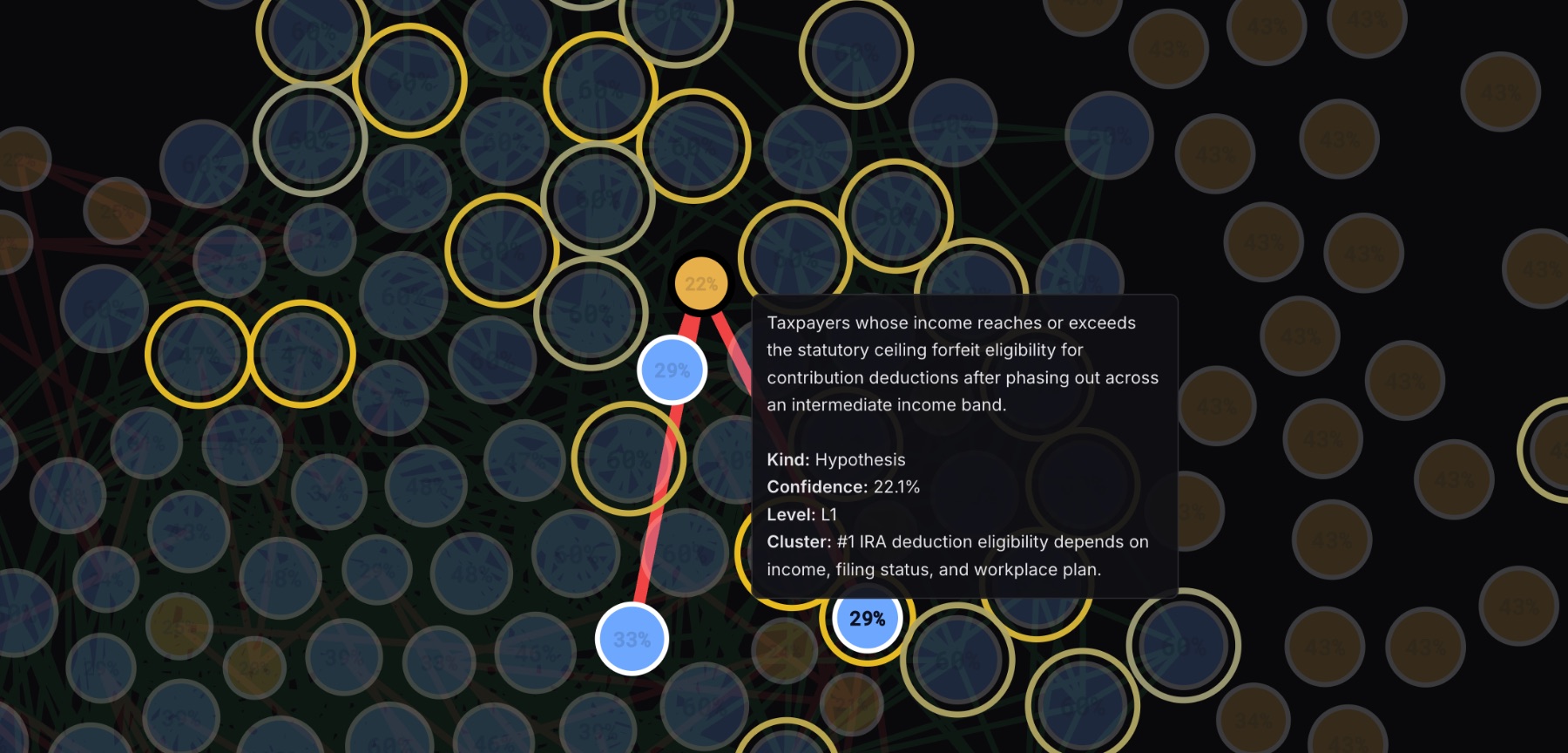

Dissonance is a force, not a bug. Two beliefs that cannot be reconciled create a local instability. Reasoning concentrates there and works to resolve it, with no new input required.
This is continual reasoning under uncertainty. It holds several live hypotheses, reaches provisional conclusions, and never stops at a final answer. It is not continual learning: the belief state changes, not the weights. It is not chain of thought: the system decides what to reason about, across the whole belief state.
Forces make some next states more likely than others. A transition, once made, becomes history. And if nothing happens between two updates, perhaps the update is the clock.
VAnd consciousness?
None of this requires consciousness. A theory of intelligence is not yet a theory of consciousness.
Cognition can hold incompatible possibilities until evidence forces a commitment. “Mary received flowers from her husband at the office” admits more than one intent, and a belief state should keep both open. That looks quantum. Choosing a trajectory takes something more: volition. Possible futures are cognitive; preferred futures are volitional. A coupled cognitive and volitional space is one direction the lab is exploring.
From information to intelligence
- Data is observed.
- Memory is interpreted persistence.
- Reasoning is state evolution.
- Causality emerges from interaction.
- Time emerges from evolution.
Next in the series
- PART 2Information is not data
- PART 3We built AI backwards
- PART 4Compiled data and stateful reasoning
- PART 5The four forces of a belief state
- PART 6Continual reasoning under uncertainty
- PART 7Time, volition and the quantum question