FAQ
Cognitive infrastructure, belief states, dissonance and how to build with them.
1. Cognitive infrastructure
What is Dyssonance building?
Today one model, the LLM, runs almost every intelligent operation, then gets patched with memory, retrieval, tools and agents. Intelligence needs to become modular. CRUU makes that possible and powers a new category: cognitive infrastructure.
What is cognitive infrastructure?
Primitives and infrastructure to compose intelligent operations around a shared belief state. Developers build new cognitive architectures instead of working inside the limits of one model.
Why compose intelligent operations?
Different operations have different needs. No single substrate is best for all of them. Composition lets each use the right substrate while adding to the same evolving understanding.
Why does composition need a shared belief state?
Components need a shared understanding of the world they reason about, not only a channel between them. A shared belief state lets each one build on what the system already believes, doubts or has inferred, instead of rebuilding it from context.
What does the monolith to microservices analogy mean?
Software moved past monoliths by building infrastructure that let specialized services work together. AI already accumulates specialized components around the LLM. Cognitive infrastructure makes them first-class, composable parts.
Do I need to replace my existing models?
No. Dyssonance does not replace LLMs, retrieval, agents or applications. It gives them persistent reasoning state.
2. Beliefs and construals
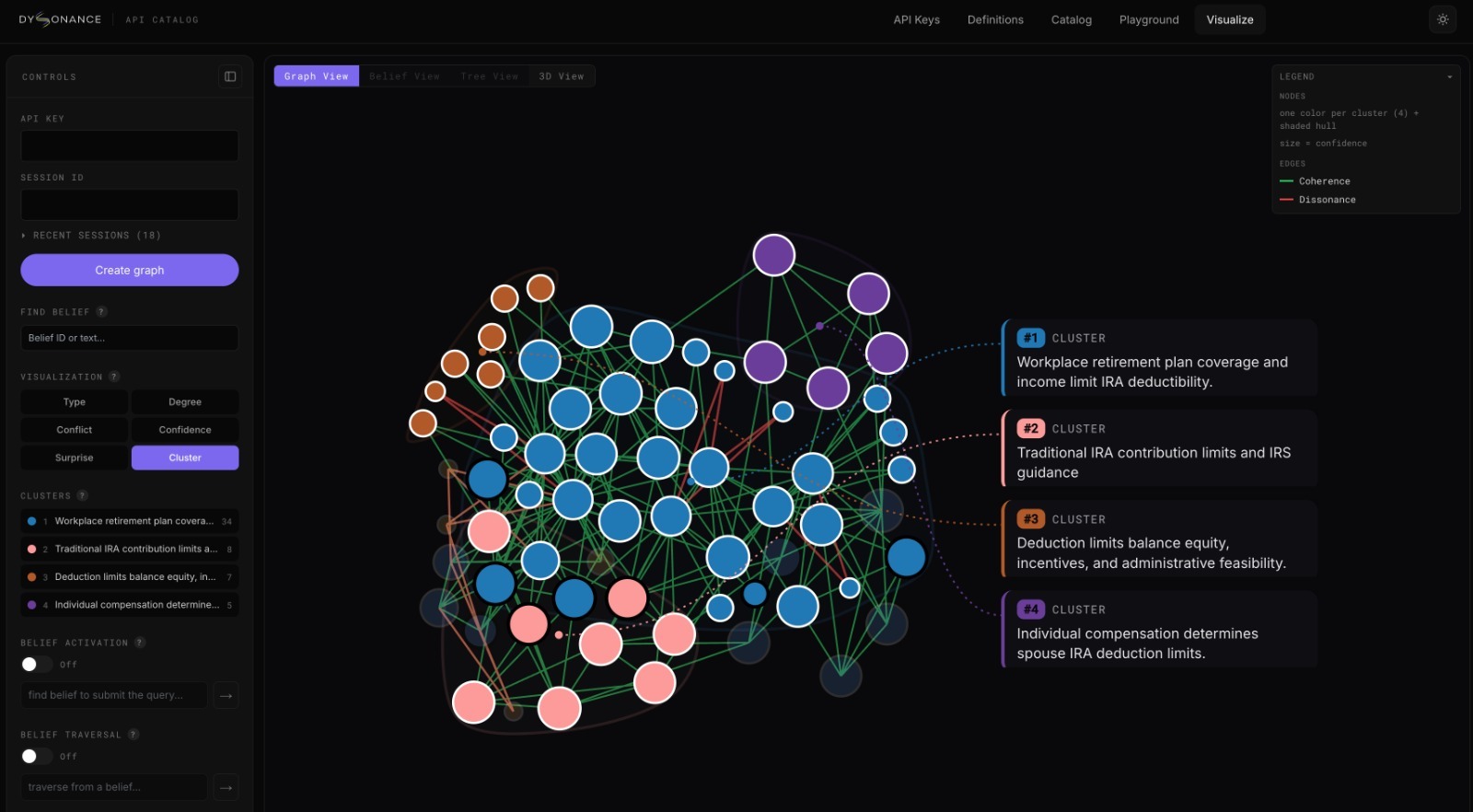
What is a belief state?
The system's evolving interpretation of the world: what it believes, what it is unsure about, and how those beliefs relate. It is compiled data that has already been reasoned over, reusable by later operations, and it keeps evolving as evidence arrives.
What is a belief?
A provisional conclusion drawn from the available evidence, with a confidence score for how strongly it is supported. Open to revision.
What is a construal?
One possible interpretation of a situation, formed from the evidence and existing beliefs. Several conflicting construals can coexist until evidence or reasoning settles them.
How is a construal different from context?
Context is the information available for one computation. A construal is an interpretation of it. The same context supports several construals, because information does not fix its own meaning.
How does a belief get updated?
When new evidence or continual reasoning changes its support. Confidence rises or falls, or the conclusion is revised or replaced.
What is provenance, and why does it matter?
Where a belief came from. Any belief can be traced back to its evidence, so a conclusion can be checked, corrected or defended.
3. Continual reasoning and dissonance
What does CRUU stand for?
Continual Reasoning Under Uncertainty. The algorithm behind Dyssonance's stateful common-sense reasoning engine.
What does it mean?
Two capabilities. Continual reasoning: cognition that drives itself, processing beyond external inputs in response to internal forces such as uncertainty or dissonance. Reasoning under uncertainty: holding ambiguous and conflicting interpretations as evidence accumulates, without resolving them too early.
What is dissonance?
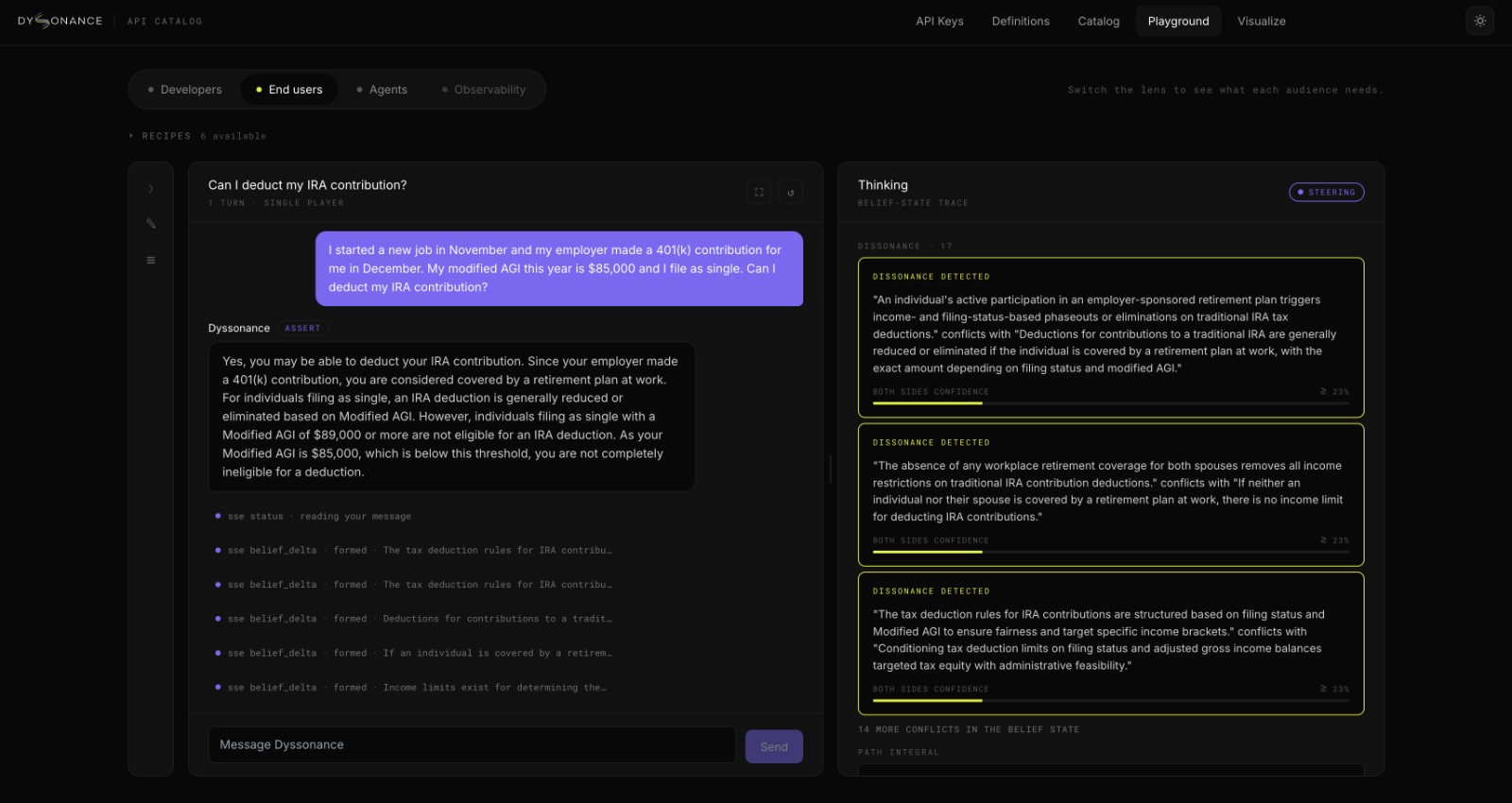
An internal tension between beliefs or construals that cannot be comfortably reconciled. CRUU either keeps that tension as a force that drives more reasoning, or forces a resolution by revising beliefs.
Why does dissonance matter so much?
It directs reasoning toward the parts of the belief state that need work, much as cognitive dissonance focuses the brain on an unresolved tension. It is one of several internal forces that drive the system.
What is an Inner World Model?
How a particular user, group or agent interprets the world. Perspectives differ, so inner world models and the belief states they produce differ too.
4. Temporality and causality
Why does intelligence need temporality?
The conclusions that matter rarely arrive at once. They emerge from evidence accumulated over time. A belief state records how each belief changed and when.
What does causality mean in Dyssonance?
Belief states hold causal and conditional structure: what produces what, and what would follow under a different condition. Competing explanations stay alive, each tied to evidence that could settle it.
5. Active inference and proactivity
What makes Dyssonance proactive?
Cognition can start from changes inside the belief state, not only from instructions, orchestration or monitoring. Dissonance and uncertainty direct attention and trigger reasoning on their own.
What is active inference?
The brain predicts what it expects to observe and compares that with what happens. Active inference reduces the resulting surprise two ways: update beliefs to explain the world better, or act to bring observations closer to what is expected.
How does uncertainty trigger information-seeking?
The system can ask what it would need to know to change a belief. A tool call, a retrieval or a question to a human can then be chosen because it is expected to reduce uncertainty or resolve dissonance.
6. Compiled intelligence and economics
What is compiled data?
Data that has already been reasoned over. A belief state is compiled: later operations reuse it directly instead of regenerating the reasoning.
Can compiled beliefs change?
Yes. They keep evolving as new evidence arrives.
Why is Dyssonance cheaper?
Most systems rebuild an approximate cognitive state from language on every run. A belief state persists and changes only when the world changes.
7. How is this different?
How is it different from an LLM?
LLMs focus on communication. Dyssonance maintains the evolving interpretation underneath. Reasoning is separated from language so each layer does what it does best.
Does Dyssonance use LLMs?
It works with them. LLMs stay the language layer. It does not depend on any single one.
How is it different from RAG and long context?
Retrieval finds information. Long context shows more of it. Both rebuild the situation on every call. A belief state keeps what the evidence means, how confident that is, what alternatives remain and what would change it.
How is it different from an agent harness?
A harness compensates with prompts, instruction files, memory files and workflow graphs. In belief-conditioned agency, the belief state determines identity, attention, reasoning and action.
8. Building with Dyssonance
How do I use Dyssonance?
Create a session, send evidence, and work with the belief state that forms: interrogate it, subscribe to it, diagnose and correct it, analyze its coherence.
What is the Dyssonance Platform?
The API catalog of reasoning primitives, a playground to test them, and views to inspect sessions and belief states.
Can I connect tools and external data sources?
Yes. Documents, messages, databases, system events, model and agent outputs, tool activity and human feedback, as a fixed corpus or a live stream.
Can different components share the same belief state?
Yes. That is the point of cognitive infrastructure: every component builds on the same evolving understanding.
Do I have to rebuild my existing application?
No. Applications read from the belief state through the API, MCP and event subscriptions.
9. Safety
Does a persistent belief state make AI easier to inspect?
Yes. Each belief carries its confidence, provenance, supporting and conflicting evidence, and dependencies. Errors can be found and fixed at the level of reasoning.
Can you understand why the system changed its beliefs?
Every belief traces back to its evidence, and changes to beliefs are recorded over time.
What happens when Dyssonance is uncertain?
Uncertainty is part of the state. With conflicting evidence, it surfaces dissonance. With missing evidence, it seeks more instead of bluffing. For high-consequence actions, it can require more evidence or a human.
10. Challenge the thesis
How do you know this is an architecture gap, not a capability gap?
Reasoning requires state. A better model that still rebuilds the situation on every call still loses what it concluded last time.
Test the thesis on your own sources.