FAQ
Cognitive infrastructure, belief states, dissonance and how to build with them.

Cognitive Infrastructure
What is Dyssonance building, and why does this category exist?
What is Dyssonance building?
Today, we ask one model (the LLM) to perform almost all intelligent operations, including many it was never built to perform in the first place, then patch in what it can't: memory, retrieval, tools, agents, and more. We believe AI has reached the same kind of architectural problem software faced with monoliths: intelligence needs to become modular.
Dyssonance built CRUU (Continual Reasoning Under Uncertainty) to make that possible. CRUU powers a new category we are pioneering, Cognitive Infrastructure, where specialized cognitive components work together around a shared belief state rather than relying on a single model to do everything.
What is Cognitive Infrastructure?
Cognitive Infrastructure provides the primitives and infrastructure to seamlessly compose intelligent operations around a shared belief state, allowing developers to effortlessly build entirely new cognitive architectures instead of working within the boundaries of a single model. This enables capabilities such as intelligent simulations, intelligent replays, and Theory of Mind, without the challenges that arise when trying to build them around LLMs such as context loss, repeated reconstruction of state, and brittle orchestration.
Why compose intelligent operations?
Different intelligent operations have different requirements, and no single substrate is optimal for all of them. Composition lets each operation use the substrate best suited to it while still contributing to the same evolving understanding.
What does it mean for intelligence to be natively composable?
Composable intelligence allows those heterogeneous operations to build directly on one another without translating everything back into prompts or reconstructing state. A shared belief state makes their results immediately and natively available to the rest of the cognitive system.
Why does composable intelligence need a shared belief state?
Composable intelligence needs more than communication between components: it needs a shared understanding of the world they are reasoning about. A shared belief state lets every intelligent operation build on what the system already knows, believes, doubts, or has inferred, instead of reconstructing that state from context.
What does the monolith → microservices analogy mean?
Software didn't move beyond monoliths simply by breaking them into pieces, but by building infrastructure that allowed specialized services to work together. AI is already accumulating specialized components around the LLM; Cognitive Infrastructure turns those patches into first-class, composable parts of the system.
Do I need to replace my existing models?
No. Dyssonance does not replace LLMs, retrieval, agents or applications. It gives them persistent reasoning state.
Beliefs & Construals
How does the system represent what it thinks is happening?
What is a belief state?
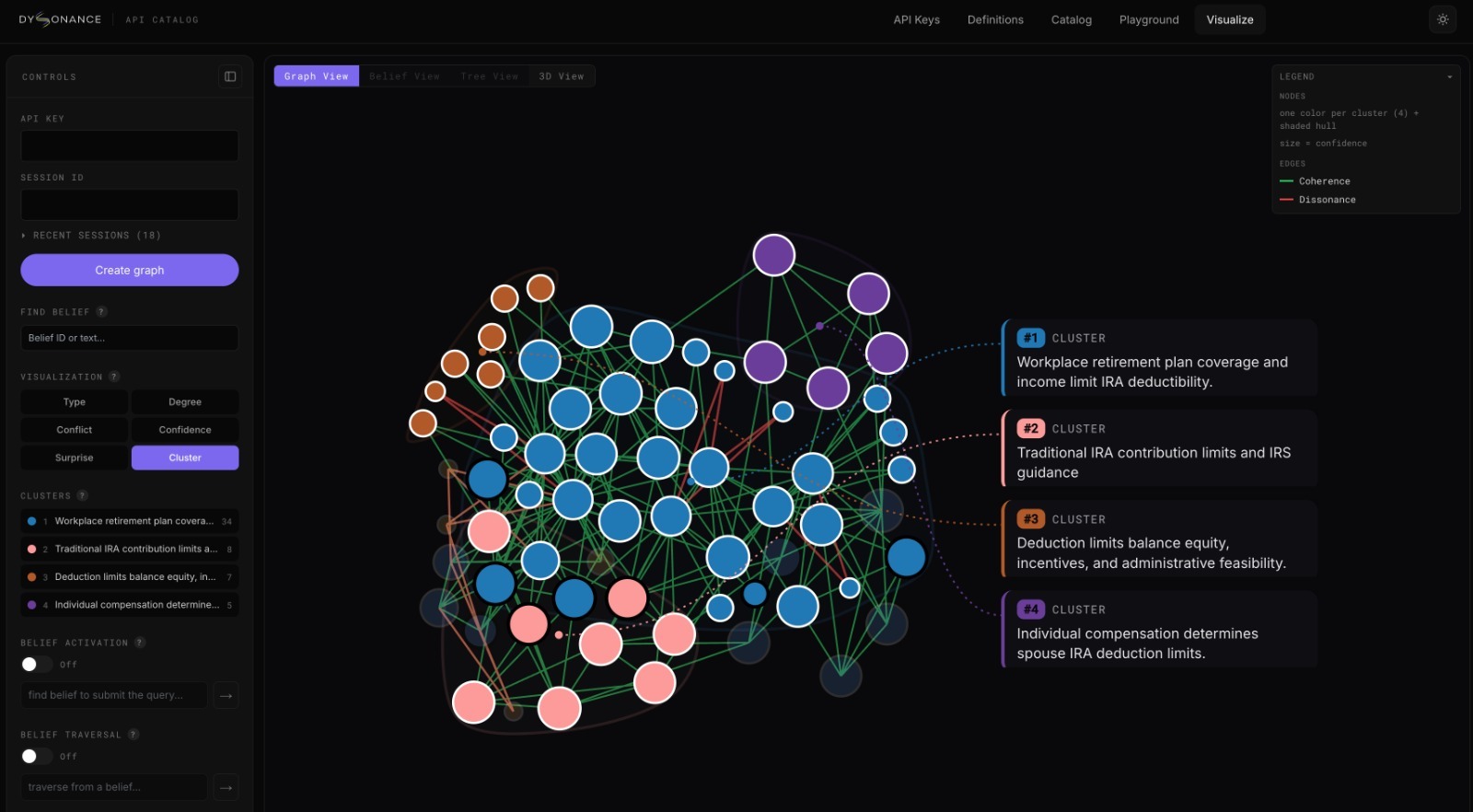
A belief state is the system's evolving epistemic state, representing its current interpretation of the world, what it believes, what it is uncertain about, and the relationships between those beliefs. It is compiled data that has already undergone reasoning and can be directly reused by subsequent intelligent operations, while continuing to evolve as new evidence arrives.
What is a belief?
A belief is a provisional conclusion the system has drawn from the evidence available to it, paired with a confidence score representing how strongly that conclusion is currently supported. It represents the system's current position on what may be true, without requiring certainty and while remaining open to revision as evidence changes.
What is a construal?
A construal is one possible interpretation of a situation, formed from the available evidence and the system’s existing beliefs. Dyssonance can hold several potentially conflicting construals simultaneously, without prematurely collapsing them into a single interpretation, until further evidence or reasoning warrants doing so.
How is a construal different from context?
Context is the information available to a system for a particular computation, while a construal is the system’s interpretation of a situation based on that information and its existing beliefs. The same context can support multiple, potentially conflicting construals because information does not uniquely determine what it means.
How does a belief get updated?
A belief is updated when new evidence or continual reasoning changes the support for a provisional conclusion. Its confidence may increase or decrease, or the conclusion itself may be revised or replaced.
What is provenance, and why does it matter?
Where a belief came from. Any belief can be traced back to its evidence, so a conclusion can be checked, corrected or defended.
Continual Reasoning & Dissonance
How does cognition evolve rather than restart?
What does CRUU stand for?
CRUU stands for Continual Reasoning Under Uncertainty. It is the algorithm powering Dyssonance’s stateful common-sense reasoning engine.
What does “Continual Reasoning Under Uncertainty” mean?
Continual Reasoning Under Uncertainty is fundamentally the combination of two capabilities. Continual reasoning refers to cognition that can be self-driven, continuing to process information beyond external inputs in response to internal forces such as uncertainty or dissonance. Meanwhile, reasoning under uncertainty means the system can reason without prematurely resolving ambiguity, maintaining uncertain and potentially conflicting interpretations as evidence accumulates.
What does it mean for reasoning to be continual?
Continual reasoning refers to a cognitive process that can drive itself, persisting latently beyond any individual task or input rather than ending once an input has been processed. Internal forces such as dissonance drive further reasoning and belief updates, progressively stabilizing the system’s state.
What is (cognitive) dissonance?
Cognitive dissonance is an internal tension that arises when the system’s current beliefs or construals are contradictory and / or cannot be comfortably reconciled. Based on the overall state of the belief state, CRUU might decide to preserve that tension as an internal force that drives further reasoning and belief updates toward stabilization, or force a resolution by revising its own beliefs.
Why is dissonance so important to our system?
Dissonance acts as a repulsive force between beliefs or construals that cannot be comfortably reconciled. Much like cognitive dissonance can cause the brain to focus on an unresolved tension, dissonance directs CRUU’s reasoning toward parts of its belief state that require further processing; it is one of several internal forces that drive the system’s cognitive dynamics.
What is an Inner World Model?
How a particular user, group or agent interprets the world. Perspectives differ, so inner world models and the belief states they produce differ too.
Temporality and causality
Why does intelligence need temporality?
The conclusions that matter rarely arrive at once. They emerge from evidence accumulated over time. A belief state records how each belief changed and when.
What does causality mean in Dyssonance?
Belief states hold causal and conditional structure: what produces what, and what would follow under a different condition. Competing explanations stay alive, each tied to evidence that could settle it.
Active Inference & Proactivity
How does the system determine what to think about next?
What makes Dyssonance proactive?
Dyssonance is proactive because cognition can be initiated by changes and forces within the system’s own belief state, rather than requiring external instructions, orchestration or monitoring. Dissonance, uncertainty, and other internal forces can direct attention and trigger further reasoning, allowing the system to identify what requires cognitive work on its own.
What is active inference?
The brain continuously predicts what it expects to observe and compares those predictions with what actually happens. Active inference describes how an intelligent system can reduce the resulting surprise either by updating its beliefs to better explain the world, or by acting on the world to bring observations closer to what it expects.
How does uncertainty trigger information-seeking?
The system can ask what it would need to know to change a belief. A tool call, a retrieval or a question to a human can then be chosen because it is expected to reduce uncertainty or resolve dissonance.
Compiled intelligence and economics
What is compiled data?
Data that has already been reasoned over. A belief state is compiled: later operations reuse it directly instead of regenerating the reasoning.
Can compiled beliefs change?
Yes. They keep evolving as new evidence arrives.
Why is Dyssonance cheaper?
Most systems rebuild an approximate cognitive state from language on every run. A belief state persists and changes only when the world changes.
How Is This Different?
Isn't there already something that does this?
How is it different from an LLM?
LLMs focus on communication. Dyssonance maintains the evolving interpretation underneath. Reasoning is separated from language so each layer does what it does best.
Does Dyssonance use LLMs?
It works with them. LLMs stay the language layer. It does not depend on any single one.
How is Dyssonance different from RAG?
Retrieval-Augmented Generation (RAG) helps language models find information relevant to a query, but relevance is not the same as truth. RAG systems can retrieve outdated information, favor frequently repeated claims over better-supported evidence, or surface contradictory sources without resolving them. These limitations arise because retrieval does not inherently distinguish statistical prevalence from epistemic confidence, or track how the validity of information changes over time.
Dyssonance takes a fundamentally different approach. Rather than repeatedly reconstructing an interpretation from retrieved passages, it maintains a persistent Belief State representing its current understanding of the world, including uncertainty, contradictions, and relationships between beliefs, allowing it to recognize when information becomes outdated, loses relevance, or needs to be retired.
Through Continual Reasoning Under Uncertainty (CRUU), beliefs evolve as new evidence arrives, allowing the system to revise its interpretations and reuse previously established understanding.
How is it different from an agent harness?
A harness compensates with prompts, instruction files, memory files and workflow graphs. In belief-conditioned agency, the belief state determines identity, attention, reasoning and action.
Building with Dyssonance
How do I use Dyssonance?
Create a belief state, send evidence, and work with what forms: interrogate it, subscribe to it, diagnose and correct it, analyze its coherence.
What is the Dyssonance Platform?
The API catalog of reasoning primitives, a playground to test them, and views to inspect belief states.
Can I connect tools and external data sources?
Yes. Documents, messages, databases, system events, model and agent outputs, tool activity and human feedback, as a fixed corpus or a live stream.
Can different components share the same belief state?
Yes. That is the point of cognitive infrastructure: every component builds on the same evolving understanding.
Do I have to rebuild my existing application?
No. Applications read from the belief state through the API, MCP and event subscriptions.
Safety
Does a persistent belief state make AI easier to inspect?
Yes. Each belief carries its confidence, provenance, supporting and conflicting evidence, and dependencies. Errors can be found and fixed at the level of reasoning.
Can you understand why the system changed its beliefs?
Every belief traces back to its evidence, and changes to beliefs are recorded over time.
What happens when Dyssonance is uncertain?
Uncertainty is part of the state. With conflicting evidence, it surfaces dissonance. With missing evidence, it seeks more instead of bluffing. For high-consequence actions, it can require more evidence or a human.
Challenge the thesis
How do you know this is an architecture gap, not a capability gap?
Reasoning requires state. A better model that still rebuilds the situation on every call still loses what it concluded last time.
Test the thesis on your own sources.